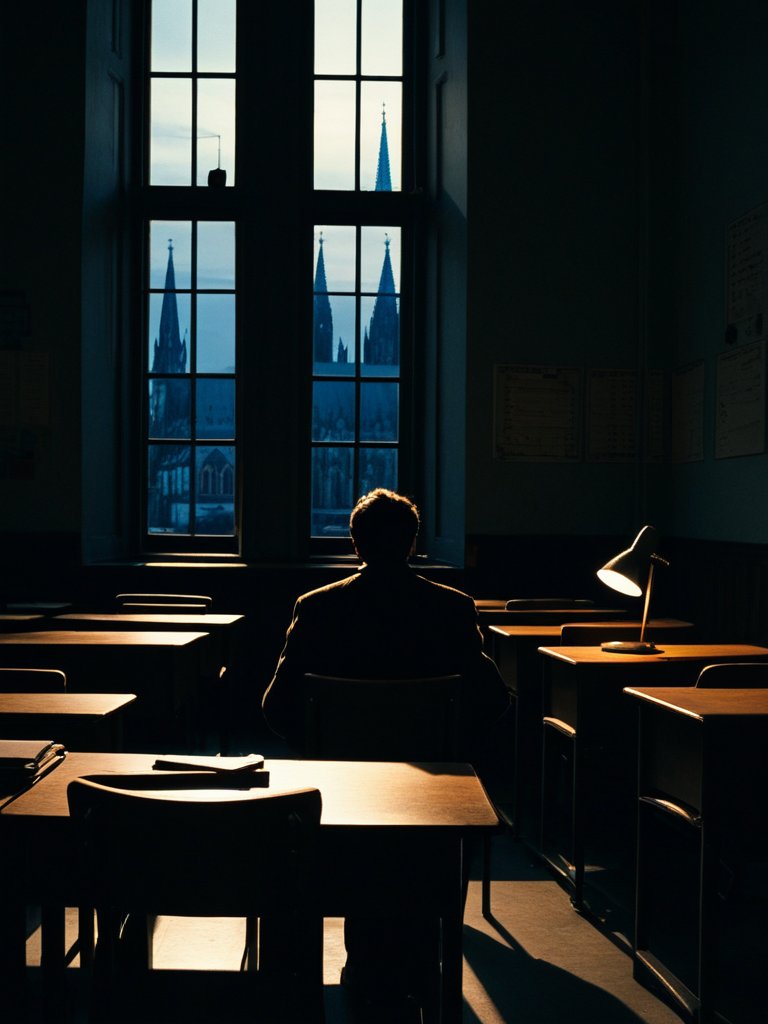
Tuesdays and Thursdays I close the salon at six, wash the colour off my hands, and take the tram across Cologne to sit in a classroom with people ten years younger than me. I am Selin, twenty-nine, a master hairstylist with my own two chairs, and I am going back for the diploma I walked out on at seventeen. Nine months. I have a calendar in the staff room with the exam date circled.
Dr. Henrik Voss teaches German. He is somewhere past forty, wears the same grey jacket every week, and marks essays the way other men chop wood: fast, hard, without looking up. In class he has said perhaps forty words to me, all of them about commas.
His margins are another matter.
Tonight he hands the essays back face down. Mine has red all over it, the usual, and then at the bottom of the last page, in the small neat hand he uses only there: You write about your mother's hands as if you're afraid to say you have the same ones. Say it. It would be the best sentence in the room.
I read it three times. Around me chairs scrape, people leave. When I look up, he is packing his bag and not looking at me with great precision.
“Dr. Voss.” My voice is steadier than I feel. “Do you write this much to everyone?”
He stops. The room is empty now, just the two of us and the hum of the strip lights. He looks at the essay in my hands, then at my face, and for a second the jacket and the commas fall away and he is simply a man who has been caught. “No,” he says. Then he picks up his bag. “Thursday. The essay on the novella. Read the notes before you read the grade.” He is at the door before I can answer, and I am standing in a classroom with a page that says more than any conversation we've had, deciding whether I'm going to keep reading between his lines or make him say it out loud.